
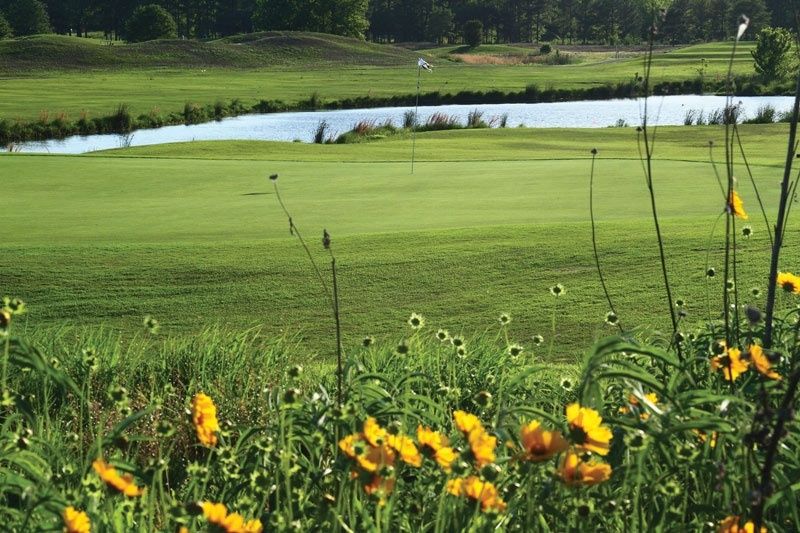
Rethinking the Green Oasis in British Golf
For decades, golf courses were often judged by the uniformity of their turf. A dense, vividly green playing surface was treated as evidence of quality, while rough grass, scrub, standing water and seasonal colour were viewed as signs of neglect. That assumption is now being challenged. Across Britain, well-managed courses are showing that a facility can deliver firm, consistent, championship-calibre playing conditions while also restoring habitats that support pollinators, birds, amphibians, reptiles and small mammals.
The change is being driven by practical pressures as much as environmental ambition. Hotter summers, prolonged droughts, intense rainfall and tighter restrictions on water abstraction are exposing the weakness of management systems built around regular irrigation and high inputs. The response is not to abandon standards, but to redefine them. More resilient grasses, carefully managed roughs, better drainage and evidence-based irrigation can reduce costs and operational risk while making the course more robust. In that sense, natural restoration is becoming part of sound agronomy rather than a separate charitable project.

The Agronomic Transition from Thirsty Turf to Resilient Fescues
Annual meadow grass and some shallow-rooted bentgrass populations can produce attractive surfaces, but they are vulnerable when heat and drought persist. Their limited rooting depth means that available soil moisture is quickly exhausted. During a prolonged dry period, the turf may thin, lose colour and become open to invasion by opportunistic species. The drought conditions of 2018 demonstrated how weakly rooted areas could subsequently be colonised by annual meadow grass, creating an ongoing quality problem rather than a short-term cosmetic issue.
Fescues offer a more resilient alternative where soil, traffic and course design are suitable. Red fescues, sheep”s fescue, Chewings fescue and hard fescue can develop deeper and more extensive root systems, tolerate lower fertility and maintain useful playing qualities with less water. They are not a universal replacement, and establishment requires proper seed-to-soil contact, suitable cultivars, sensible overseeding and careful traffic management. Nevertheless, the case for using them on appropriate fairways, surrounds and roughs is strengthened as drought becomes more frequent. Practical guidance from The R&A”s Golf Course 2030 resources also stresses that preparation, informed turf care and clear communication with golfers are central to managing extreme weather.
The key distinction is not simply whether a course uses irrigation, but how much intervention is required to keep different turf areas functional. A sensible comparison helps committees identify where changes will deliver the greatest return.
| Management factor | Conventional high-input sward | Fescue-led resilient sward |
|---|---|---|
| Water demand | Higher, particularly during heat and drought | Lower once established, although establishment still requires care |
| Fertiliser demand | Often higher to maintain rapid growth and colour | Generally lower, with restrained nutrition supporting fine-leaved turf |
| Mowing pressure | Frequent mowing may be needed to maintain uniformity | Can require less intensive growth management in suitable areas |
| Drought response | May thin quickly when shallow roots exhaust soil moisture | Better tolerance of dry conditions through deeper rooting and hardier leaves |
| Establishment risk | Usually familiar and relatively predictable | Dependent on cultivar choice, soil contact, moisture and follow-up husbandry |
Fescue management still demands skill. Decompaction, low-disturbance aeration, targeted coring and sensible nutrient planning help roots explore the soil profile. Excessive irrigation can encourage shallow rooting, while unnecessary fertiliser may favour more competitive grasses. The objective is a stable plant community that performs well under realistic conditions, not an artificially forced surface that collapses when weather or water availability changes.
Building Stepping Stones for Threatened Wildlife
A golf course is rarely one habitat. It is a mosaic of greens, tees, fairways, roughs, woodland, ponds, ditches, hedgerows, banks and out-of-play ground. When those elements are managed as connected features, they can provide stepping stones through landscapes where housing, roads and intensive agriculture have fragmented natural habitats. Tree canopies can offer shelter and nesting sites, while lightly managed roughs provide flowering plants and overwintering areas for insects. Even a narrow strip beside a boundary fence can become useful if it is managed for continuity rather than neatness alone.
The conservation value of these areas depends on management quality. Simply leaving grass uncut does not automatically create good habitat. Dominant grasses and scrub can suppress wildflowers, while poorly timed operations may destroy nests or remove seed heads before they mature. Cutting and collecting arisings, varying mowing dates, protecting veteran trees and selecting locally appropriate seed can gradually improve diversity. More than 100 English golf courses are designated Sites of Special Scientific Interest, and many other courses contain valuable roughs or habitat features that are not formally protected but still contribute to regional ecological networks.
Course managers do not need to work in isolation. Landscape-scale partnerships can provide survey expertise, seed advice, ecological targets and access to wider funding or habitat programmes. The Purple Horizons Nature Recovery Project demonstrates how local authorities, researchers and environmental organisations are reconnecting heathland, meadow and woodland between major nature reserves. Its work includes reducing mowing, restoring wildflower-rich grassland, creating nesting habitat and developing pollinator corridors. Golf facilities can apply the same principle at a smaller scale by linking roughs, tree lines, ponds and boundary habitats rather than treating each feature as a separate island.
- Map existing roughs, ponds, veteran trees, hedgerows and unmanaged margins before changing them.
- Identify gaps between habitats and use native planting or adjusted mowing to improve continuity.
- Time cutting and clearance around flowering, nesting and seed-setting periods wherever safety allows.
- Record butterflies, moths, birds and notable plants so members can see measurable progress.
- Use county wildlife trusts, local authorities and ecological consultants where specialist survey work is required.
Smarter Hydrology and Reduced Inputs Behind the Scenes
Water resilience begins with knowing where water comes from, where it is used and where it is lost. The R&A”s updated Golf Course 2030 Water Portal provides an interactive way for operators to examine projected changes in rainfall and temperature affecting individual courses. It also covers water-use monitoring, borehole abstraction, drainage, legislation and implementation options, supported by 22 case studies from the UK and Europe. For a club committee, the value lies in turning a general climate concern into a site-specific plan with priorities, likely disruption and indicative costs.
That assessment can lead to relatively straightforward improvements. Metering irrigation zones, repairing leaks, adjusting sprinkler coverage, irrigating at appropriate times and separating essential playing surfaces from lower-priority areas can reduce demand without compromising the whole course. Soil moisture monitoring and weather data are more reliable than visual colour alone. A slightly brown, firm fairway may be agronomically healthy, while a permanently lush surface may indicate excessive irrigation and weak root development.
Water infrastructure can also become habitat infrastructure. Attenuation ponds slow stormwater and reduce pressure on drainage systems, while reed beds can help filter sediment and nutrients before runoff reaches streams or rivers. With appropriate design and maintenance, these features provide breeding and refuge areas for wetland species. Integrated pest management follows the same principle of targeted intervention. Regular scouting, threshold-based decisions, cultural controls and improved plant health can reduce reliance on broad-spectrum chemicals.
- Measure water use by zone rather than relying only on the total annual bill.
- Use the Water Portal to assess future rainfall, temperature and regulatory pressures.
- Inspect drainage, storage and abstraction arrangements before investing in additional irrigation capacity.
- Design ponds and reed beds for both hydraulic performance and ecological value.
- Adopt integrated pest management, using treatments only when monitoring shows they are justified.
How Member Culture and Ecolabels Are Changing the Game
Technical improvements will struggle if members expect every playing surface to remain uniformly emerald throughout a dry summer. A more realistic standard accepts seasonal colour, firmer ground and visible habitat edges as signs of responsible management. The playing challenge may even improve when fairways are firm and well-drained, provided bounce, roll and surface consistency remain within acceptable limits. Communication matters here. Members are more likely to support a conservation rough when the club explains its purpose, marks its boundaries and reports what has been found there.
Independent frameworks can help distinguish genuine progress from attractive claims. GEO Certified is administered by the not-for-profit GEO Certification Ltd and is designed for facilities, developments and tournaments. Its framework covers nature, resource conservation, climate action and community considerations, with an emphasis on continual improvement. Certification does not remove the need for local judgement, but it gives committees a structured way to document objectives, actions and results. The broader GEO sustainable golf platform also provides practical resources and examples from a wide range of golf settings.
There is growing evidence that high-quality play and habitat recovery can coexist on chalk downland. Regional work has recorded rare butterflies and wildflowers thriving beside active fairways where grazing, mowing and scrub control are carefully planned. A documented example from the South Downs shows how rare species can flourish on a Sussex golf course without removing the course from active use. The lesson is not that every club should copy a particular scheme, but that ecological value depends on informed management of the whole site.
- Agree a clear definition of acceptable seasonal playing conditions with members and the greenkeeping team.
- Set measurable habitat objectives, such as increased wildflower cover, improved pond condition or recorded butterfly species.
- Publish a simple annual report showing water use, input reductions, habitat work and survey findings.
- Use external certification or ecological review to test whether the plan is delivering real outcomes.
- Train volunteers and staff so that conservation areas are maintained consistently rather than left to chance.
Securing the Next Century of the Fairway Landscape
The safest starting point for a club is a modest, visible trial. Select a low-risk rough beside a boundary, behind a tee or around an existing habitat feature. Establish a baseline, agree mowing dates, remove arisings where appropriate and monitor the result for two seasons. This approach avoids committing the whole course to an untested change and gives members a practical demonstration of how restoration works. If the trial improves biodiversity without affecting pace of play, safety or maintenance access, it can be extended gradually.
Conservation should be treated as long-term risk management. Lower water demand reduces exposure to drought restrictions, reduced inputs can control operating costs, and healthier soils and plant communities can improve recovery after extreme weather. The aim is not to make golf courses look untidy or to sacrifice playing quality. It is to direct intensive care towards the surfaces that need it most, while allowing suitable areas to perform as living infrastructure.
- Begin with a course-wide habitat and water audit.
- Prioritise fescue conversion where soil, traffic and play requirements make it realistic.
- Create one or two managed conservation roughs with clear objectives and signage.
- Invest first in monitoring, drainage and irrigation efficiency before expanding water demand.
- Build working relationships with local conservation partnerships and independent specialists.
- Report progress plainly, including setbacks, seasonal variation and lessons learned.
British golf”s future will not be secured by preserving an artificial image of permanent summer. It will be secured by understanding the landscape beneath the course and managing it with greater precision. Clubs that embrace their wild heritage can protect playing quality, strengthen financial resilience and provide meaningful refuges for wildlife. The modern fairway is not a barrier between sport and nature. Properly managed, it is one of the places where both can continue to thrive.